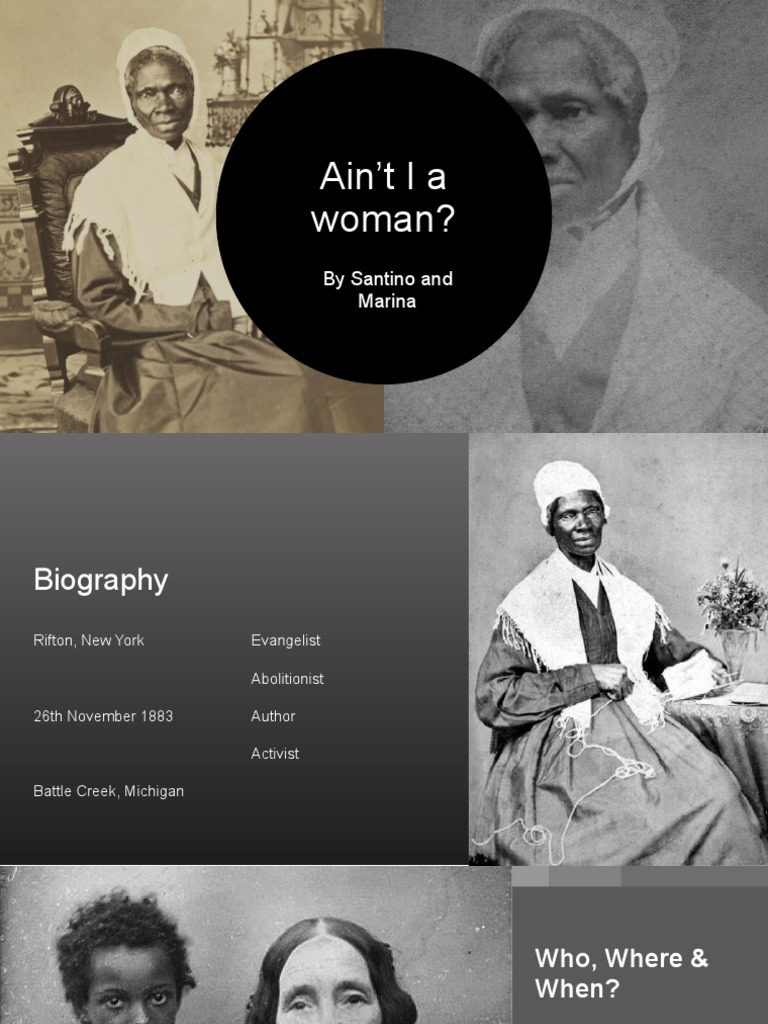
In the pantheon of feminist oratory, few speeches resonate with the raw, unfiltered fury of Sojourner Truth’s “Ain’t I a Woman?”—a 19th-century cri de coeur that still reverberates through the corridors of time. Delivered in 1851 at the Ohio Women’s Rights Convention, this impassioned address dismantled the suffocating myths of femininity, race, and labor with a bluntness that feels almost prophetic today. It was not merely a speech; it was a Molotov cocktail hurled at the gilded cages of patriarchal and racist dogma. Nearly two centuries later, its echoes persist, not as a relic of the past, but as a living manifesto demanding reckoning. This is the story of a woman who refused to be erased, and the indelible mark she left on the fight for equality.
The Unapologetic Defiance of Sojourner Truth
Sojourner Truth was no meek supplicant at the altar of respectability politics. Born into bondage as Isabella Baumfree, she endured the dual horrors of slavery and misogyny before emerging as a towering figure in the abolitionist and women’s rights movements. Her speech was a masterclass in intersectional defiance, a rhetorical sledgehammer that shattered the fragile illusion of white, middle-class femininity as the sole archetype of womanhood. With phrases like “Ain’t I a woman?” she exposed the hypocrisy of a society that lauded the delicate virtues of white women while relegating Black women to the status of chattel, their humanity dismissed with a shrug.
The power of Truth’s words lay in their simplicity. She did not rely on flowery prose or academic jargon; instead, she wielded plainspoken truth like a blade. “I have plowed and planted, and gathered into barns, and no man could head me!” she declared, her voice a thunderclap against the myth of female fragility. This was not just a challenge to gender norms—it was a dismantling of the entire edifice of oppression, brick by brick. Her rhetoric was a mirror, forcing her audience to confront the grotesque disparities they had conveniently ignored.
The Intersectional Crucible: Race, Gender, and Labor
Truth’s speech was a seismic event because it refused to compartmentalize oppression. She did not speak of womanhood in isolation, nor did she allow the white feminists of her time to reduce her to a mere footnote in their struggle. Instead, she wove together the threads of race, gender, and labor into a tapestry of resistance that remains urgently relevant. The Black woman’s body, she argued, was not a passive vessel for the fantasies of others—it was a site of relentless toil, of unpaid labor, of stolen dreams. “Where did your Christ come from?” she demanded, her words a direct assault on the religious justifications for slavery and subjugation. The implication was clear: if Christ could emerge from the womb of a marginalized woman, then who were white men to claim moral superiority?
This intersectional lens was revolutionary for its time, and it continues to shape modern feminist discourse. Today, when we talk about the gender pay gap, we must acknowledge that Black women earn, on average, 63 cents for every dollar earned by white men—a statistic that underscores the compounded oppression Truth so eloquently exposed. Her speech was a precursor to Kimberlé Crenshaw’s theory of intersectionality, a reminder that liberation cannot be achieved through siloed activism. The fight for women’s rights is inseparable from the fight against racism, classism, and all other forms of systemic dehumanization.
The Myth of the “Weak” Female Body
One of the most enduring legacies of “Ain’t I a Woman?” is its dismantling of the myth of female fragility. Truth’s physical prowess—her ability to “plow and plant” alongside men—was not an anomaly but a testament to the resilience of women who had been forced into labor from the moment they could walk. Yet, this strength was systematically erased by a society that preferred its women delicate, dependent, and decorative. The speech was a rejoinder to this erasure, a declaration that womanhood was not a synonym for weakness. “I have borne thirteen children, and seen most all sold off to slavery,” she stated, her words a gut-punch to the sentimentalized narratives of motherhood that white feminists often peddled.
This myth persists in insidious ways today. From the infantilization of women in media to the persistent wage gap, the idea that women are somehow less capable than men is a lie that refuses to die. Truth’s speech was a rallying cry against this lie, a reminder that women—especially women of color—have always been the backbone of labor, the architects of survival, and the unacknowledged engines of progress. Her words challenge us to rethink what it means to be a woman, to reject the narrow definitions imposed by a patriarchal society, and to embrace a vision of strength that is unapologetic and uncompromising.
The Religious Hypocrisy and the Divine Feminine
Truth’s speech was not just a political manifesto; it was a theological intervention. She wielded the language of Christianity with a precision that exposed its contradictions. “That man over there says that women need to be helped into carriages, and lifted over ditches, and to have the best place everywhere,” she scoffed. “Nobody ever helps me into carriages, or over mud-puddles, or gives me any best place!” Her words were a direct challenge to the hypocrisy of a religion that preached equality in the pulpit but practiced oppression in the pews. If God was love, then where was the love for the enslaved, the exploited, the silenced?
This critique of religious hypocrisy remains a potent force in modern feminist thought. From the exclusion of women from religious leadership to the weaponization of faith to justify oppression, Truth’s words remind us that no institution is above scrutiny. Her speech invites us to question the narratives we’ve been taught, to demand that our spiritual and moral frameworks align with justice rather than complicity. The divine feminine, she implied, was not a passive ideal but an active, rebellious force—one that refused to be confined by the dogmas of men.
The Legacy: From 1851 to the Present
The impact of “Ain’t I a Woman?” cannot be overstated. It was a catalyst for the women’s suffrage movement, a touchstone for Black feminist thought, and a precursor to the intersectional feminism we champion today. Yet, its relevance is not confined to history books. In an era where women’s rights are under siege in countries around the world, where reproductive freedoms are being rolled back, and where the bodies of marginalized women are still treated as commodities, Truth’s words feel like a battle cry. They remind us that the fight for equality is not a relic of the past but a living, breathing struggle that demands our participation.
Modern feminists would do well to revisit Truth’s speech, not as a historical artifact, but as a living text. Her words challenge us to confront the ways in which oppression persists, to recognize the intersections of our struggles, and to demand a justice that is not partial but total. The fight for women’s rights is not a single-issue campaign; it is a multifaceted revolution that requires us to see the connections between racism, sexism, classism, and all other forms of oppression. Truth’s speech was a masterclass in this kind of holistic thinking, and it remains a blueprint for the work that lies ahead.
The Unfinished Revolution
Sojourner Truth’s “Ain’t I a Woman?” is more than a speech; it is a manifesto for a revolution that is still unfolding. It is a reminder that the fight for equality is not a linear progression but a cyclical struggle, one that demands constant vigilance and unyielding resistance. The questions she posed—”Ain’t I a woman? Ain’t I a sister?”—are not rhetorical flourishes but urgent demands for recognition, for justice, for humanity. They are questions that echo in the streets of modern protests, in the boardrooms where women fight for equal pay, in the classrooms where young girls are told they must be “likable” to succeed.
To read Truth’s speech today is to be confronted with the uncomfortable truth that the work is not done. The echoes of her words are a challenge, a call to action, a demand that we do better. They remind us that feminism is not a monolith but a dynamic, evolving movement—one that must center the voices of those who have been historically silenced. The revolution she envisioned is not a distant dream; it is a present imperative. And it begins with the courage to ask, again and again: Ain’t I a woman?