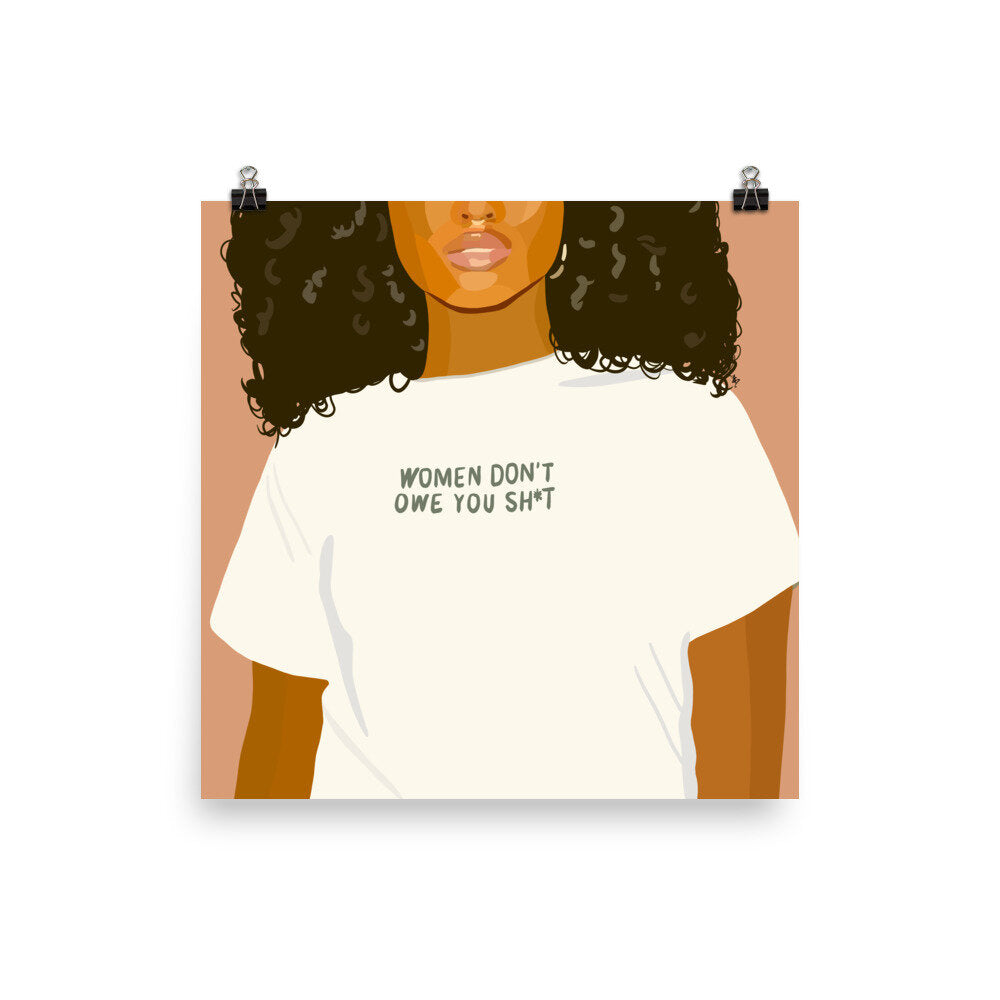
In contemporary discourse surrounding feminism and gender dynamics, a poignant phrase has emerged that encapsulates a widespread frustration: “Women don’t owe you a debate; they owe you a block.” This assertion is more than a provocative quip—it reflects a profound commentary on societal expectations, power imbalances, and the ways in which women’s voices are often subjected to unwarranted scrutiny and challenge. Far beyond a simple call for digital distancing, this statement addresses a pervasive cultural phenomenon where women are habitually expected to justify, explain, or defend their lived experiences simply for occupying space in public conversation. Unpacking this phrase reveals layers of gendered assumptions, emotional labor, and the necessity for boundaries within interactions both online and offline.
Understanding the Cultural Zeitgeist of Feminist Discourse
To grasp the resonance of “Women don’t owe you a debate,” it’s essential to consider the broader cultural context in which feminist voices operate. Feminism, at its core, challenges established hegemonies and demands equity where oppression once reigned. The movement contends with centuries of patriarchal norms that have positioned women’s perspectives as secondary or negotiable. Consequently, every feminist assertion is often met not merely with disagreement, but systematic interrogation designed to delegitimize the speaker. The phrase captures a moment of resistance against this exhausting onslaught of interrogation—where women push back, indicating that their lived truths are not up for debate, nor should they be forced into continual justification.
The Emotional Labor of Defending One’s Identity and Experience
Engaging in debate, especially surrounding issues of gender, requires immense emotional labor, a concept that feminists have long highlighted in their critiques of social dynamics. Emotional labor extends beyond mere physical or cognitive effort; it encompasses the management of one’s emotions to fulfill social expectations. When women are repeatedly compelled to explain their choices, defend their autonomy, or navigate hostile discourse, they expend significant mental and emotional resources. This persistent demand not only diminishes their capacity for self-expression but also perpetuates a dynamic where their worth and credibility are constantly interrogated. The demand for “a block” metaphorically and literally signifies reclaiming mental space, emphasizing self-preservation over the obligation to appease or educate detractors.
The Persistent Fascination with Policing Women’s Voices
Why is there such an enduring fixation on challenging women’s assertions? This curiosity delves into patriarchal anxieties and societal discomfort with empowered female narratives. Historically, female voices have been marginalized or tokenized, limiting agency and influence. Hence, when women begin to articulate their viewpoints unapologetically, it disrupts ingrained power structures. The ensuing fascination often manifests as resistance aimed at maintaining status quo privileges. Furthermore, this perpetual scrutiny exposes deep-rooted insecurities about shifting gender roles and the destabilization of male-centric narratives. By refusing to engage in debates designed to police their voice, women intercept this cycle of validation and challenge the legitimacy of patriarchal oversight.
The Digital Arena: Social Media as a Battleground
In the digital age, social media platforms serve as microcosms of larger societal power dynamics. For women, these spaces are simultaneously arenas of empowerment and vulnerability. The call to “block” rather than debate is particularly salient in online environments, where harassment, trolling, and dismissive commentary are rampant. Unlike in face-to-face interactions, online engagement often lacks nuance and invites performative aggression. The anonymity afforded by the internet emboldens critics to dehumanize and undermine feminist voices with impunity. Thus, the block functions not just as a tool of disconnection but as a necessary boundary to preserve psychological well-being and cultivate a safer conversational space. It is an act of defiance and self-care entwined.
The Intersectionality of Demands and Silencing
The admonition that women are not obligated to debate also intersects deeply with the concept of intersectionality. Women from marginalized backgrounds—be it racial, socioeconomic, or sexual minorities—experience compounded challenges in asserting their perspectives. The imperative to continuously justify one’s identity or political stance increases exponentially when structural inequalities are factored in. The admonition to “block” resonates strongly for these women, who often face disproportionate backlash and erasure. It underscores the fact that the expectation to debate is one more layer of burden placed unevenly on women, especially those navigating multiple axes of oppression.
The Philosophical Implications of Refusing Debate
Refusing to debate can also be interpreted through a philosophical lens, particularly concerning the nature of dialogue and discourse ethics. Traditional debate assumes a marketplace of ideas where rational deliberation leads to truth or consensus. However, when power imbalances skew this marketplace, dialogue becomes performative rather than genuine. Women declining to engage signify a challenge to these flawed premises—they recognize that certain argument environments are inherently unjust and designed to undermine rather than illuminate. This refusal to participate in the debate is a radical assertion of autonomy, signaling a rejection of false equivalences and manipulative dichotomies.
Empowering Women Through Boundary Setting
Ultimately, the call for women to prioritize “a block” over a debate highlights the importance of boundary-setting within feminist praxis. Empowerment is not solely about vocalizing demands or effecting policy changes; it also entails controlling the conditions of one’s participation in public and private spheres. Boundaries serve as crucial mechanisms for preserving dignity, agency, and psychological safety. When women claim the right to disengage from hostile or exhausting interactions, they assert control over their narratives and environments. This principle extends beyond digital contexts into everyday life, emphasizing that respect for women includes recognizing when their presence in conversation should be accepted without contestation.
Conclusion: Toward a Culture of Respect and Autonomy
The phrase “Women don’t owe you a debate; they owe you a block” is a catalyst for reimagining how society engages with women’s voices. It calls attention to the pervasive expectation for women to justify their existence and clarifies the need for healthier, more equitable interactions. By respecting women’s choice to prioritize their mental and emotional well-being—whether through dialogue or exclusion—society takes a step toward dismantling entrenched patriarchal norms. The deeper fascination with policing women’s voices can only be overcome by embracing respect, autonomy, and the recognition that sometimes, the most powerful response is silence and self-preservation rather than argumentation.