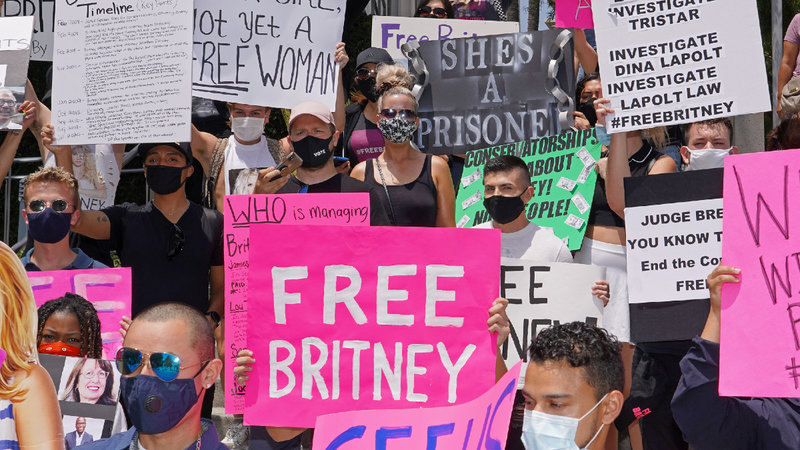
The #FreeBritney movement wasn’t just a hashtag—it was a seismic cultural reckoning, a digital uprising where the personal became political, and the private became public. What began as a whisper among devoted fans of Britney Spears evolved into a global chorus demanding justice, autonomy, and the dismantling of a system that had long exploited women under the guise of care. This wasn’t merely about a pop icon; it was about the insidious ways society polices female ambition, mental health, and bodily autonomy. The movement forced us to confront uncomfortable truths: that freedom is never truly granted—it is seized, and that the cages we build around women are often gilded with concern.
The Myth of Consent and the Illusion of Choice
Britney Spears’ conservatorship was not an anomaly—it was a grotesque manifestation of a society that treats women, particularly those who dare to wield power, as perpetual children. The legal framework of conservatorship, ostensibly designed to protect the vulnerable, became a tool of control, stripping away autonomy under the pretense of benevolence. This wasn’t just about money or fame; it was about the erasure of a woman’s right to make her own choices, to speak her own mind, to live her own life. The #FreeBritney movement exposed the hypocrisy of a culture that celebrates female empowerment in theory but criminalizes it in practice. When Britney was forced into a gilded cage, the world watched—but few dared to question the system that built it.
The conservatorship was a masterclass in gaslighting. Britney was told she was “too unstable” to manage her own life, yet the very institution claiming to protect her was the one dictating every aspect of it. This is the paradox of patriarchal protection: it cloaks domination in the language of care, making resistance seem like ingratitude. The movement forced us to ask: Who gets to decide what a woman’s freedom looks like? And why do we so readily accept that a woman’s autonomy is negotiable?
The Digital Rebellion: How the Internet Became a Battleground
The #FreeBritney movement was a digital insurrection, a testament to the power of collective action in an era where social media is both a weapon and a shield. Fans, activists, and survivors of similar systems didn’t just amplify Britney’s voice—they created a space where her silence could no longer be weaponized. The internet became a sanctuary where truth could flourish, where the cracks in the conservatorship’s facade were exposed in real time. This wasn’t just about saving one woman; it was about reclaiming the narrative from those who had spent years profiting off her suffering.
Yet, the digital rebellion was not without its contradictions. The same platforms that gave birth to the movement also commodified it, turning Britney’s pain into a spectacle for consumption. The irony is stark: a movement born from a demand for autonomy was co-opted by the very systems it sought to dismantle. But here’s the truth—no amount of algorithms or corporate greed could silence the core demand of #FreeBritney: justice. The movement proved that when women refuse to be silenced, the world is forced to listen, even if it takes decades.
The Ripple Effect: How Britney’s Fight Changed the Conversation
The impact of #FreeBritney extended far beyond the pop culture sphere. It emboldened other women to challenge the systems that sought to control them, from legal guardianships to workplace discrimination. Survivors of abusive relationships saw their own struggles reflected in Britney’s story, realizing that the cages they lived in were not just personal failures but systemic failures. The movement gave a name to the unspoken: the quiet terror of being trapped, the exhaustion of fighting an invisible war, the relief of finally being heard.
But the ripple effect wasn’t just about solidarity—it was about accountability. The conservatorship’s collapse sent shockwaves through legal and medical systems, forcing a reckoning with the ways we treat women in crisis. Britney’s testimony in court was not just a personal victory; it was a cultural indictment. It exposed the rot at the heart of institutions that claim to protect but too often exploit. The movement didn’t just free Britney—it exposed the fragility of the systems that sought to control her.
The Backlash: Why the Fight Isn’t Over
Of course, no revolution is met without resistance. The backlash to #FreeBritney was swift and predictable. Critics dismissed the movement as a fan frenzy, a conspiracy theory, a distraction from “real” issues. Others clung to the myth of Britney as a “troubled woman,” refusing to acknowledge the structural forces that had shaped her suffering. The backlash wasn’t just about Britney—it was about the fear of what her liberation represented. If Britney could break free, what did that say about the systems that had kept so many others trapped?
The truth is, the fight isn’t over. Britney’s freedom is a milestone, not a finish line. The same systems that sought to control her are still in place, still targeting women who dare to defy them. The conservatorship may be over, but the cultural conditioning that led to it persists. The movement’s legacy is a reminder that freedom is not a one-time achievement—it is a daily struggle against the forces that seek to confine women, whether in gilded cages or invisible ones.
The Future: What Comes After the Hashtag?
The #FreeBritney movement didn’t just change the conversation—it redefined what activism could look like in the digital age. It proved that collective action, when fueled by authenticity and rage, can dismantle even the most entrenched systems. But the question remains: what comes next? How do we ensure that Britney’s freedom isn’t an exception but a precedent?
The answer lies in the uncomfortable work of dismantling the myths that keep women trapped. It lies in challenging the institutions that claim to protect but too often exploit. It lies in recognizing that Britney’s story is not an outlier—it is a symptom of a society that has always feared female power. The #FreeBritney movement didn’t just free one woman; it exposed the rot at the heart of our systems. Now, the real work begins.