

















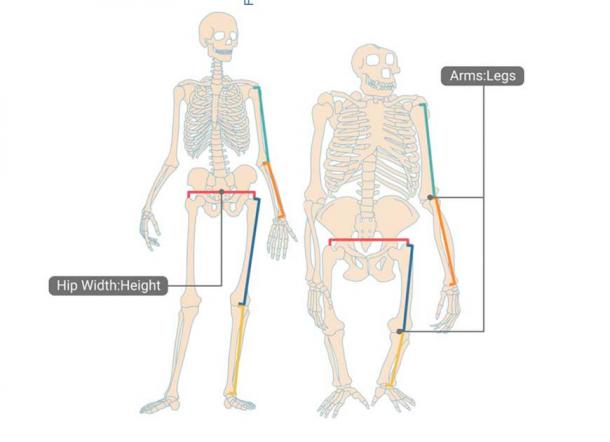
Waist-to-hip ratios (WHR) have long captivated popular culture, science, and the corridors of evolutionary psychology. A quick glance at countless headlines and casual conversations reveals an almost obsessive fascination with this slender gauge of human form. The archetype of the “ideal” female body—a narrow waist seamlessly flowing into rounded hips—has been heralded as a biological beacon signaling fertility, health, and sexual allure. Yet beneath this veneer of simplistic explanation lies a thicket of myths, misconceptions, and profound oversights that feminism and critical inquiry tirelessly challenge. What drives this fixation on WHR? Is it truly an immutable truth encoded in our genes, or have cultural, societal, and ideological forces twisted a veneer of evolutionary reasoning into something far less straightforward?
The Waist-to-Hip Ratio: Cultural Myth or Biological Fact?
The widely cited evolutionary psychology narrative posits that a low WHR—around 0.7—acts as an unconscious signal to prospective mates of reproductive viability and general health. But here lies the seductive problem: the purported universality of this claim crumbles under scrutiny. Cross-cultural surveys illustrate a kaleidoscope of preferences, often influenced more by local norms, media representations, and shifting socio-economic conditions than by static biological imperatives. In some societies, higher WHRs predominate as the pinnacle of feminine desirability, contradicting the simplistic biologically deterministic thesis. The almost fetishistic elevation of WHR in Western media resembles less a reflection of human nature and more an echo chamber of culturally constructed aesthetics draped in pseudo-scientific garb.
Deconstructing Evolutionary Psychology’s Single-Factor Fascination
Evolutionary psychology often distills complex human behaviors into elegant, singular causalities. Waist-to-hip ratio is no exception—a neatly packaged signal of fertility and health that claims to explain millennia of mate selection in a single numerical value. This reductionism is at best an oversimplification, and at worst a form of intellectual hubris. Human attraction is a symphony of multifaceted signals: voice timbre, scent, facial symmetry, personality, social intelligence, and beyond. To isolate WHR as the paramount criterion is to indulge in a cherry-picking of data that suits a favoured narrative. Moreover, the mutation and plasticity of human preferences reveal that what may have been advantageous—or merely prevalent—in one epoch or environment cannot be linearly transposed onto contemporary society without substantial qualifiers.
Feminist Perspectives: Challenging Sanitized Narratives of Female Attractiveness
Feminist critiques shatter the sanitized evolutionary self-assurance surrounding WHR as a marker of innate desirability. They illuminate how this focus perpetuates constricting ideals that tether female worth to quantifiable physical traits, often weaponizing biology against women. The celebration of a specific bodily ratio as a universal standard paradoxically erases the lived diversity of female bodies and experiences. It implicitly sustains patriarchal hierarchies by naturalizing beauty standards that funnel women into commodifiable and surveilled templates. The obsession with WHR is less about biology and more about control—about defining who is visible, desirable, and worthy within a society obsessed with regulating female corporeality.
Biological Variability and the Myth of Universal Attraction
Diverse populations reveal a stunning range of waist-to-hip configurations shaped by genetics, environment, and lifestyle. This biological variability flies in the face of the monolithic evolutionary claim. Research in non-Western cohorts highlights that preferences often align with socio-cultural priorities such as status, wealth symbolism, and health markers that are not captured by a mere ratio. Furthermore, hormonal and metabolic theories that link low WHR strictly with fertility overlook the ecological and social complexities influencing reproductive success. The fixation on WHR reduces women to genetic vessels rather than acknowledging their embodied subjectivities, roles, and agency within interconnected social systems.
The Role of Media and Capital in Propagating Waist-to-Hip Ideals
The media’s relentless promulgation of “ideal” female body shapes functions less as a mirror and more as a lamp—casting a deliberate glow that guides cultural taste and consumer behavior. Waist-to-hip ratio becomes a metric not solely about biology but about capitalizing on insecurities to fuel industries of fashion, diet, and cosmetic modification. This commodification distorts the evolutionary psychology narrative, transforming a contested hypothesis about mate preferences into a commercial imperative. The proliferation of photo manipulation, fitness regimes, and surgical enhancements amplifies a homogenized aesthetic while silencing alternative embodiments. In this light, the fascination with WHR transcends science, becoming a battlefield over bodily autonomy and cultural hegemony.
Psychological Depths Behind the Waist-to-Hip Fascination
Beneath the surface of WHR obsession lies a labyrinth of psychological impulses and social currents. It taps into a primal schema where body shape symbolizes not just fertility but vitality, social role, and identity. The waist-to-hip narrative leverages deep-rooted archetypes—circles of femininity, the hourglass as a vessel of creation—that intertwine myth, symbol, and biology. However, these meanings are mutable, evolving with changing gender roles and feminist critiques that reclaim corporeal self-definition. The contemporary discourse reframes WHR from an immutable attractor toward a contested terrain where power, desire, and resistance intersect.
Reclaiming the Narrative: Beyond Waist-to-Hip Metrics
De-centering waist-to-hip ratio in discussions of attractiveness and female embodiment is not a denial of biology, but an invitation to richer, more inclusive narratives. Feminism invites a reclamation of bodies as complex, autonomous, and defiant against reductive metrics. Attraction involves reciprocal recognition that transcends mere biometrics, embracing emotional, intellectual, and cultural dimensions. In dismantling the myths around WHR, there emerges a call to honor diversity and complexity, challenging both pseudo-biological determinism and patriarchal commodification. This broader vision encourages liberation from narrow ideals toward expansive understandings of femininity and human connection.
Conclusion: Dispelling the Waist-to-Hip Siren Call
The waist-to-hip ratio myth represents a potent mix of scientific hubris, cultural myopia, and patriarchal fascination. It seduces with its promise of neat evolutionary explanations but fractures under the weight of empirical diversity and critical interrogation. Feminism’s unflinching gaze reveals how this obsession with corporeal metrics serves ideological ends that constrain rather than liberate. Only by peeling back the seductive layers of WHR fascination can a more honest, nuanced, and humane dialogue about attraction, identity, and embodiment flourish. The “ideal” ratio may still linger as a cultural relic—but its mythic authority, once exposed, begins to dissolve in the diverse realities of human life.