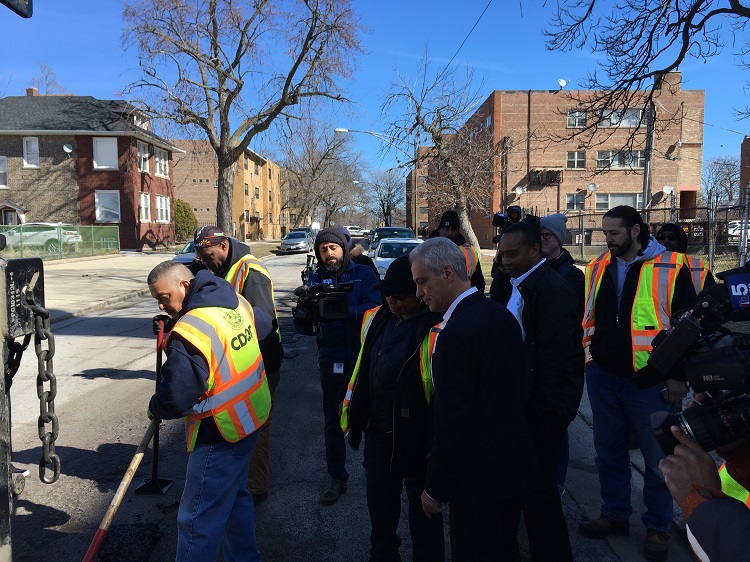
In the labyrinthine corridors of power, where concrete cracks mirror the fractures in societal norms, a mayor strides forward—not just to mend asphalt, but to dismantle the bedrock of patriarchy itself. The image of a leader kneeling in the muck of urban decay, wrench in hand, is more than a PR stunt; it’s a manifesto etched in tar and labor. This is not just about filling potholes. It’s about filling the voids in justice, equity, and the unspoken hierarchies that have long dictated who fixes what—and who gets fixed.
The Illusion of Neutral Infrastructure
Cities are not neutral. They are the frozen footprints of power, where every road, bridge, and traffic light whispers tales of who belongs—and who is an afterthought. The pothole, that ubiquitous symbol of neglect, is not merely a divot in the pavement; it’s a silent indictment of systemic oversight. Who suffers most when streets crumble? Who is forced to navigate these hazards while the architects of urban decay remain comfortably ensconced in air-conditioned offices? The answer is as predictable as it is infuriating: women, particularly those of color, who bear the brunt of inadequate public infrastructure. Sidewalks that vanish into darkness, bus stops without shelters, streets devoid of crossings—these are not accidents. They are the physical manifestations of a world designed by men, for men.
From Asphalt to Advocacy: The Feminist Reconstruction
But what if the mayor wielding the shovel wasn’t just repairing roads—what if they were repairing the very idea of who deserves to be seen? The act of fixing potholes becomes a radical act when it’s framed as dismantling the patriarchal scaffolding that has long prioritized male-centric urban planning. Consider the humble pothole: a gaping maw in the city’s belly, yet one that disproportionately endangers women walking home late at night, caregivers pushing strollers, or elderly individuals navigating uneven terrain. By addressing these flaws, the mayor isn’t just smoothing out the city’s skin; they’re stitching up the wounds of a system that has long ignored half its inhabitants.
The feminist city is not a utopian fantasy. It is a tangible, if nascent, reality being forged in the crucible of everyday labor. When a leader rolls up their sleeves to fix a pothole, they are also fixing the narrative that women’s needs are secondary. They are saying, with a trowel in hand, that safety is not a privilege—it is a right. And that right begins with something as simple, and as revolutionary, as a well-maintained sidewalk.
The Gendered Geography of Urban Decay
To understand the stakes, one must first recognize the gendered geography of urban spaces. Women’s mobility is not just hindered by potholes; it is circumscribed by a city that treats their presence as an afterthought. Studies have shown that women are more likely to use public transit, walk, or bike—modes of transport that are systematically underserved in male-dominated urban planning. The result? A landscape where women are perpetually navigating a gauntlet of obstacles, from poorly lit streets to benches that double as exclusionary design choices. The pothole, then, is not an isolated flaw. It is a symptom of a deeper rot—a rot that has long treated women’s experiences as collateral damage in the name of efficiency or cost-cutting.
But here’s the twist: when a mayor takes to the streets with a crew to fix these flaws, they are not just repairing concrete. They are repairing the social contract. They are signaling that the city’s infrastructure is not a male preserve, but a shared responsibility. This is feminism in action—not as a theoretical abstraction, but as a lived, breathing practice of equity.
The Symbolism of the Shovel
The shovel is a weapon. Not in the way of war, but in the way of reclamation. When a leader digs into the dirt to fill a pothole, they are also digging into the foundations of patriarchy. The act is symbolic, yes, but symbols are the currency of change. They are the visible cracks in the monolith of tradition, the chinks in the armor of complacency. A mayor with a shovel is a mayor who understands that power is not just wielded in boardrooms or legislative chambers—it is wielded in the grit and grime of the everyday.
This is not to say that symbolism alone will dismantle systemic oppression. But symbols are the seeds from which systemic change grows. When a leader demonstrates that the labor of repair is not beneath them—that it is, in fact, a sacred duty—they are redefining what leadership looks like. They are saying that the work of justice is not the domain of the elite, but the responsibility of all. And that, in itself, is a feminist act.
Beyond the Pothole: The Long Game of Feminist Urbanism
Of course, fixing potholes is just the beginning. The real work lies in reimagining the city as a feminist space—one where every street, park, and public transit line is designed with the needs of women and marginalized genders at its core. This means lighting that doesn’t flicker out at dusk, sidewalks wide enough for strollers and wheelchairs, and transit schedules that accommodate the unpredictability of care work. It means recognizing that the city is not a static entity, but a living, breathing organism that must evolve to meet the needs of all its inhabitants.
The mayor who fixes potholes is not just a mayor. They are a harbinger of a new urban order—one where the cracks in the pavement are not just filled, but where the very foundations of inequality are excavated and rebuilt. This is the promise of feminist urbanism: a city that doesn’t just tolerate women’s presence, but actively invites them to shape its future.
The Ripple Effect: How One Act Inspires a Movement
When a leader takes to the streets with a shovel, they do more than repair asphalt. They inspire a ripple effect that extends far beyond the pothole’s edge. They signal to other leaders that the work of equity is not a distant ideal, but a present-tense reality. They show that feminism is not just about smashing glass ceilings, but about filling in the potholes that have long barred women’s full participation in public life.
This is the power of the tangible. In a world where systemic change often feels like an abstract concept, the act of fixing a pothole is a tangible, visible step toward justice. It is a reminder that feminism is not a monolith, but a mosaic of actions—large and small—that collectively reshape the world. And when that mosaic includes a mayor with a shovel, it becomes a masterpiece.
The Unfinished Road Ahead
Yet for all its promise, the road ahead is still unfinished. The pothole fixed today may be filled with tomorrow’s cracks if the underlying systems of inequality remain unchallenged. The real test of feminist leadership is not in the photo opportunities, but in the sustained commitment to reimagining the city as a space of true equity. It is in the policies that ensure women’s voices are not just heard, but centered. It is in the budgets that prioritize the needs of the most vulnerable over the whims of the powerful.
So let us celebrate the mayor with the shovel. Let us recognize the symbolism of their labor. But let us also demand more. Let us demand a city where the work of repair is not just a photo op, but a way of life. A city where the potholes are filled, and the patriarchal potholes of the past are filled in for good.