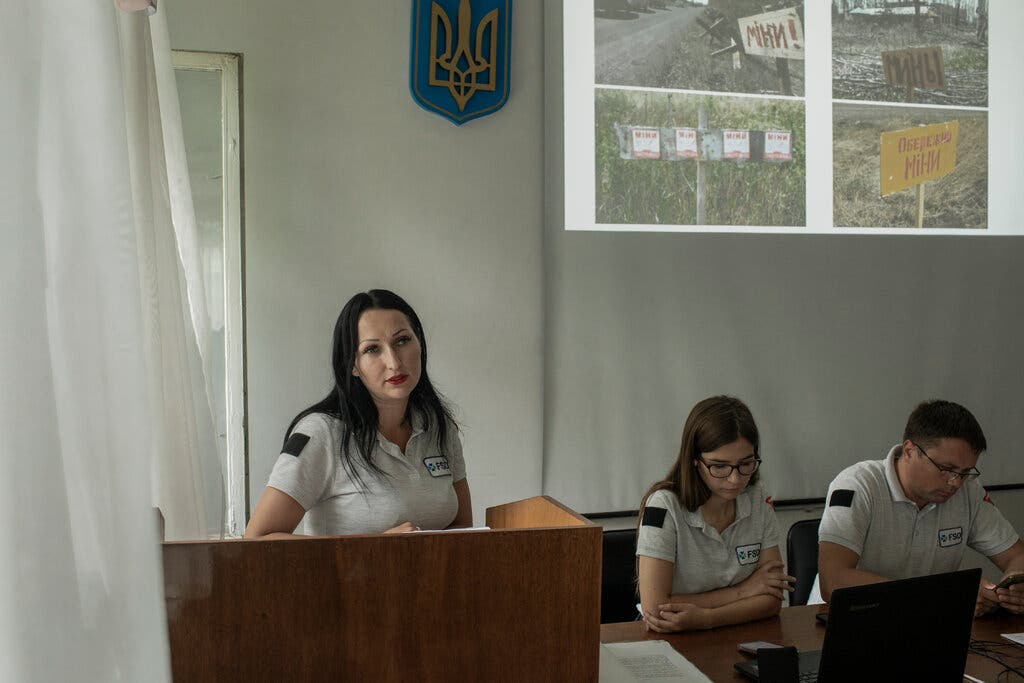
What if the loudest battlefields for feminism aren’t the ones we stage with placards and parades, but the ones marked by the muzzle flashes of guns and the erasure of rights in the quiet corners of our world? Picture this: A woman in Ukraine, now a sniper at dawn, with the weight of a weapon strapped to her back—a far cry from the coffee-table feminism of decades ago. Meanwhile, across oceans, a Yemeni mother stands in a tent, her children wrapped in rags, whispering to herself in a language no one records: *”What kind of life waits for a daughter who grows up with no horizon but the horizon of a bombing range?”*
Ads
This isn’t merely a story about two wars. It’s about a dilemma: How do we reconcile the urgency of a feminist reckoning in a crisis with the stubbornness of a system that tells women in these spaces their pain can wait? And why should the war in Ukraine, already flooded with global attention, demand our moral compass while the war in Yemen lurks as a distant statistic?
The War Zone as Feminist Battleground: Ukraine’s Paradox of Empowerment and Suppression
Ukraine’s war isn’t just a war of nations; it’s a fracture in feminist progress. For decades, Ukrainian women navigated the gendered divides imposed by a hyper-masculinized society—marriage as a cage, domestic duties as destiny, political representation as a novel concept. Then came the full-throated assault of war, and with it, a seismic shift: Ukrainian women rose. They formed paramilitary brigades like the Aydar Corps, ran hospitals at gunpoint, smuggled weapons across borders, and redefined motherhood as an act of defiance rather than subjugation. Their battlescapes are as visceral as they are visceral in their contradictions.
Herein lies the paradox: empowerment at war is not empowerment by any measure a feminist movement should celebrate. The frontlines here are not spaces where women’s agency thrives but survives. Their “liberation” is a fragile construct built on the ashes of societal collapse. Where once their rights were negligible, now they’re either weaponized by the war itself or left to rust with no infrastructure to sustain them post-conflict. The feminist question begs: Is this transformation temporary? Or is it the world’s crude mistake in teaching women how to fight while their homes burn?
The Silenced Feminist Front: Why Yemen’s War is a Blind Spot
While European skyline newsrooms scramble for angles on Lviv’s coffee culture or Kyiv’s street art, Yemen’s war chooses not to perform. The Houthi conflicts are not framed with women’s narratives; instead, they’re rendered as fodder for the global humanitarian industry: starving children, collapsing hospitals, and the occasional story of resilience, always sanitized of the sharp, gendered blades cutting through it.
Yet, Yemen’s feminist crisis is no less visceral. Women there operate in a slow violence that defies urgency, where rape used as a weapon of war becomes normalized and dowries become barter for survival. In Sana’a’s labyrinthine alleys and Aden’s refugee camps, mothers teach their daughters early: “Bend like grass so the storm doesn’t break you—but not so much that your bones grow weak.” The absence of feminist activism here isn’t a vacuum but a consent—a collective capitulation to a system where being “liberated” means choosing between a rifle or a suffocating chador.
The Global Audacity of Selective Moral Attention
It’s bold how easy it is to applaud Ukrainian women’s resistance while forgetting that feminism demands more than just a new kind of hero. The same platforms that applaud their combat roles turn a blind eye to why millions of Yemeni women lack access to basic reproductive healthcare in the world’s largest cholera outbreak. The disconnect is willful, resting on the assumption that some crises possess “better press value” than others.
The irony? The Ukrainian resistance narrative—so lauded for its agency narrative—is already being subverted by the war’s aftermath. When the bombs fall silent, women will be left with “victory” as an abstract ideal unless the feminist world secures for them what they couldn’t carry through the fight: safety, bodily autonomy, and political power. Meanwhile, Yemen’s women languish in a prolonged state of war without even the fleeting glory of being remembered.
Confronting an Either-Or Illusion
Feminists must push past the facile dualism of “here and now” vs. “there and later.” To reduce feminist urgency to a matter of theatre—Ukraine’s bold bravery versus Yemen’s quiet endurance—is to dismiss the very foundation of feminist solidarity. Every conflict demands intersectional solutions that don’t follow the script of global priorities. The real work lies in admitting that no war’s feminist front can be won alone—and that the ones ignored today will haunt our feminist legacy tomorrow.
The Dangerous Temptation: “Feminism at Gunpoint”
There’s a slippery slope when women’s contributions to war are mistaken for feminist advance. Ukrainian women running military units is not the same as achieving structural gender parity. In Yemen, women’s resistance to Houthi extremism through underground networks and cryptic communications is being erased by silence. Both circumstances reveal a harsh truth: when feminism is equated with survival in extremis, it becomes a hostage to the system itself rather than an adversary.
The danger is in normalizing feminism’s survival mode as progress. The moment women are celebrated for adapting to oppression, we’re already losing. What kind of victory is it when a war only proves a woman’s power by proving how far she can bend without breaking? The feminist challenge must be to break the system itself, not just endure it.
Beyond the Headlines: A Feminist Call to Arms (Without the Guns)
The fight isn’t to choose between a frontline sniper and a Yemenite refugee mother. It’s to demand that feminism recognizes and amplifies all of them—equally, fiercely, and systematically. This means: challenging aid organizations for their blind spots, funding reproductive rights in conflict zones, and refusing to let “too much tragedy” become a license to turn away.
Consider this: the women who invented social media activism during Ukraine’s Maidan protests are today ghosted by the same world that once cheered them on. Their online feminism was brilliant until it had to walk the walk in IRL ashes. The lesson? A feminist movement that thrives on spectacle but wanes in the shadow of violence is a movement in moral arrears.
The Unspoken Feminist Manifesto: A Better Way Than War
The most radical feminism is not the one that tells women to hold their own in a broken world but the one that asks why that world exists at all. Where does this blind spot originate? It’s the same one that commercially markets feminism—slapping a hashtag on activism so no one need engage with the system that created the problem. The answer lies not in tweeting, petitioning, or raising awareness, but in rebuilding the infrastructure that would have prevented the war in Yemen, and dismantling the myths we’ve built around Ukrainian women’s contributions.
A true feminist reckoning demands we see all conflicts, all struggles—whether for survival or liberation—as part of the same battle. It means not asking a woman whether she’s a victim or hero but shattering the dichotomy entirely.
The Question That Will Haunt Us: What Kind of Feminsist Are We?
In the end, the battle lines aren’t drawn between countries or cultures. They’re drawn between those who elevate feminist urgency without reservation and those who reserve feminism until it’s safe and staged. What’s the cost of selective empathy when Ukrainian women’s plight occupies airspace while Yemeni women’s drowns in silence? Is feminism, when it falters in its most extreme moments, not just fragile but profoundly complicit?
Let’s pose the question not in pity but in audacity: If these are not the wars we can’t ignore, which are?