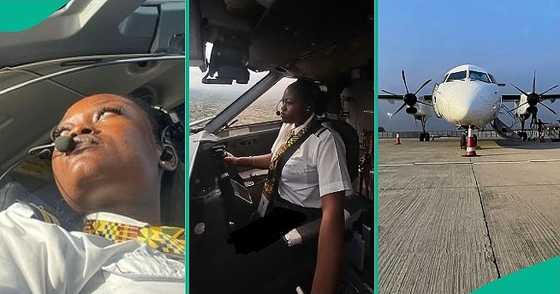
The moment the wheels kissed the tarmac, the cabin erupted—not in fear, but in a thunderous ovation. The passengers, many of whom had spent the flight gripping armrests and whispering prayers to deities they’d never invoked before, finally exhaled. The plane had landed. Smoothly. Flawlessly. But here’s the twist: the pilot at the controls was a woman. And for most of the journey, no one had known. Not until the descent began. Not until the voice crackled over the intercom, steady and assured, announcing the approach. That’s when the realization hit—this wasn’t just a safe landing. It was a quiet revolution in the skies.
The Invisible Labor of Women in High-Stakes Professions
We live in an era where competence is gendered before it’s even assessed. A woman in a cockpit isn’t just a pilot—she’s a spectacle, a deviation from the default narrative that still pictures aviators as men in epaulets. The aviation industry, like so many others, operates on the assumption that excellence is male until proven otherwise. But what happens when the proof arrives mid-flight? When the person guiding a 200-ton machine through turbulence isn’t the stereotype you expected? The cognitive dissonance is palpable. Passengers clutch their phones, half-expecting to see a man step out of the cockpit. The pilot’s gender becomes the story, not the skill. That’s not progress. That’s a failure of imagination.
Women have been flying planes since the early 20th century, yet their presence in the cockpit remains a footnote in the public consciousness. Amelia Earhart is remembered for her disappearance, not her mastery. Bessie Coleman, the first Black woman pilot, is celebrated in retrospect but ignored in real time. Today, women make up only 5% of commercial pilots globally. Five percent. In an industry that prides itself on precision, this statistic isn’t just a gap—it’s a chasm carved by systemic bias. The fact that a female pilot’s competence is still a revelation says more about our collective myopia than it does about her skill.
Breaking the Sound Barrier of Perception
There’s a term in aviation: “glass cockpit.” It refers to the transparent panels in modern planes, but it’s also a metaphor for the invisible barriers women face. Every time a female pilot takes off, she’s navigating not just weather systems, but a cultural headwind. The scrutiny is relentless. Her decisions are second-guessed. Her voice on the intercom is met with skepticism. She’s not just flying the plane—she’s flying against the assumption that she shouldn’t be. And yet, she lands. Again. And again. And again.
This isn’t just about representation. It’s about dismantling the myth that certain professions are inherently masculine. The cockpit is no more a man’s domain than the boardroom or the operating theater. But the narrative persists because it’s convenient. It’s easier to cling to stereotypes than to confront the reality that talent knows no gender. When a woman lands a plane, the applause isn’t just for the landing. It’s for the audacity of existing in a space where she wasn’t supposed to be. That’s not feminism. That’s basic human decency.
The Psychology of the “Reveal”: Why We’re Still Surprised
There’s a psychological phenomenon at play here: the “expectation violation.” When reality contradicts our deeply held beliefs, we experience discomfort. A woman pilot violates the expectation that pilots are men. The brain scrambles to reconcile the contradiction. Some passengers might even feel a flicker of betrayal—“Why didn’t I know?” The answer is simple: because society didn’t tell you. Because the media, the textbooks, the Hollywood blockbusters all conspired to erase her from the narrative before she even strapped into the seat.
This isn’t just about aviation. It’s about the way we consume competence. A man in a hard hat? Obvious. A woman in a hard hat? A “trend.” A male surgeon? Standard. A female surgeon? A “remarkable exception.” The cognitive dissonance isn’t a bug in the system—it’s a feature. It keeps the status quo intact. But what happens when the exception becomes the rule? When the reveal isn’t a shock but a non-event? That’s when we’ll know we’ve made progress.
Beyond the Cockpit: The Ripple Effect of Female Leadership
The impact of women in high-stakes roles extends far beyond the immediate task at hand. When a female pilot lands a plane, she’s not just transporting passengers from Point A to Point B. She’s transporting an idea: that leadership isn’t gendered. She’s modeling resilience for young girls who’ve been told to aim lower. She’s challenging the boys in the backseat to rethink their assumptions. She’s proving that competence isn’t a birthright—it’s a skill, honed through training and tenacity.
But the ripple effect goes deeper. Studies show that companies with diverse leadership teams are more innovative and profitable. Airline crews with female pilots have been shown to have lower accident rates. Why? Because diversity isn’t just a moral imperative—it’s a performance enhancer. When teams are homogeneous, blind spots flourish. When teams are diverse, solutions are sharper. The cockpit is no exception. A female pilot doesn’t just fly the plane—she flies with a different perspective, one that might just save lives in ways we haven’t yet imagined.
The Media’s Role in Perpetuating—or Dismantling—Biases
Media coverage of female pilots often falls into two traps: the “inspirational” narrative or the “exceptional” narrative. Either she’s a trailblazer worthy of a Lifetime movie, or she’s a statistical anomaly worthy of a footnote. Rarely is she just a professional doing her job. This framing does a disservice to everyone. It turns competence into a spectacle. It reinforces the idea that women in male-dominated fields are novelties, not norms.
Imagine if every article about a male pilot led with his gender. “Male pilot lands plane in record time!” The absurdity of the framing reveals the problem. Women shouldn’t have to be “inspiring” to be taken seriously. They should just be taken seriously. The media has a responsibility to normalize female competence, not gawk at it. When a woman lands a plane, the headline shouldn’t be about her gender. It should be about the landing.
What’s Next? The Fight for Invisible Equality
The goal isn’t for female pilots to become so common that their gender is the only thing we notice. The goal is for their gender to be irrelevant—to the point where no one bats an eye when a woman is at the controls. That’s when we’ll know the revolution is complete. Until then, every smooth landing is a quiet act of defiance. Every takeoff is a challenge to the status quo. Every voice on the intercom is a reminder that the sky isn’t the limit—it’s just the beginning.
The next time you board a plane, pay attention. Listen to the voice guiding you through the clouds. If it’s a woman, don’t clap. Don’t gasp. Just buckle up. She’s got this.