In the jagged landscape of Post-Roe America, feminism has stopped being a monolith—it is now a sprawling kaleidoscope, fracturing across states like shattered prairie glass. Suddenly, bodily autonomy isn’t a monologue; it’s a decentralized cacophony, where victories in one red state morph into battles in another, and lawyvers are the new abolitionists, waging a guerrilla war across legislative borders. What did Roe’s fall really mean beyond the headline? It revealed something far more raw: the fraught, beautiful mess of how women navigate sovereign selves in a country with no federal consensus on what it means to be a person.
I. The Abortion Divide: A Nation of 50 Policy Labyrinths
The overturning of Roe v. Wade wasn’t just an erosion of precedent—it was an act of seismic partitioning. The country splintered along state borders as if two distinct temporalities now ruled the land: one where contraceptive prescriptions can be denied to adolescents, and another where crisis pregnancy centers—dressed as “alternatives” to clinics—flourish like dandelions in spring. States like Texas and Florida have weaponized the law into a hyper-surveillance regime, mandating ultrasound photoshoots and 24-hour cooling-off periods for those who dare seek abortion. Meanwhile, Oregon and California—protected by the sanctity of their own constitutions—have become oases with a slew of telehealth innovations: med-abortion via telemedicine, online consultation “passports” (documenting treatment histories that travel digitally), and even a rooftop heli-pad clinic in Portland, where patients are whisked in via helicopter to skirt border restrictions.
But the patchwork doesn’t end with procedural hurdles. In Alabama, where abortion access is effectively nil, an underground economy emerges. Drivers with modified vehicles haul reproductive health supplies through a loosely coordinated “gray market.” These aren’t just mule operations; some involve partnerships with rural midwives who specialize in clandestine terminations using herbal methods preserved by Appalachian folk wisdom, a practice rebranded as “ancestor medicine.” Resistance, in this new landscape of scarcity, is no longer just ideological—it’s tactile, subterranean, and profoundly personal.
II. The New Battleground: Beyond Abortion, Into Fertility Warfare
Post-Roe, the war has spread from the womb to the wider reproductive matrix: fertility, sexuality, and even the rights of embryos. States like Louisiana and Georgia have outlawed elective egg freezing for single women, insisting it amounts to “delayed abortion.” Meanwhile, reproductive endocrinologists face a chilling effect: insurance may now bar IVF treatments for same-sex couples, framing it as “indiscriminate gestation,” while the “right to fatherhood” is a growing legal cause. In one Utah case, a judge denied a gay man’s custody based on the argument that he “created a zygote in a petri dish, not a child in the womb,” thus eroding the sanctity of pre-embryonic life while ignoring the medical science behind its very existence.
“Pregnent” is now a loaded monolith. The rise of the pregnancy “surrender” movement—where women leave abortion clinics to have their infants adopted via backroom brokers—picks up where the overturned right ended: a legalized exodus. It’s a macabre twist: abortion opponents now claim to honor life by “re-parenting” infants without the original mother’s consent. The irony is too heavy to ignore.
III. Digital Sovereignty: The Fight for Bodies in a Hyper-Wired America
Data is the fuel of today’s reproductive politics. Apps like Clue and Flo faced a moment of reckoning when users in some states were flagged to the FBI for sharing their menstrual cycle logs. Meanwhile, tech corporations have divided into two factions: firms like Apple and Google—under threat of regulatory strikes for offering geo-locating features that reveal proximity to clinics—aided by a dark web “mapping” where users anonymously plot safe passages for med-abortions. The backlash is palpable.
A new class of “reprotech” entrepreneurs have emerged: designers of secure messaging platforms for pill orders and “abortion escrow” services that disperse funds to providers via blockchain technology, untraceable by state surveillance. Even “friendship bracelets” are reimagined—they now embed QR codes to access encrypted health information or contact lists of local “pilots” (those who shuttle patients between states). The internet, once a beacon of freedom, is now a double-edged scalpel: a tool for both dissemination and decryption.
IV. The Visceral Politics of Care: Who Is Entitled to Be Vulnerable?
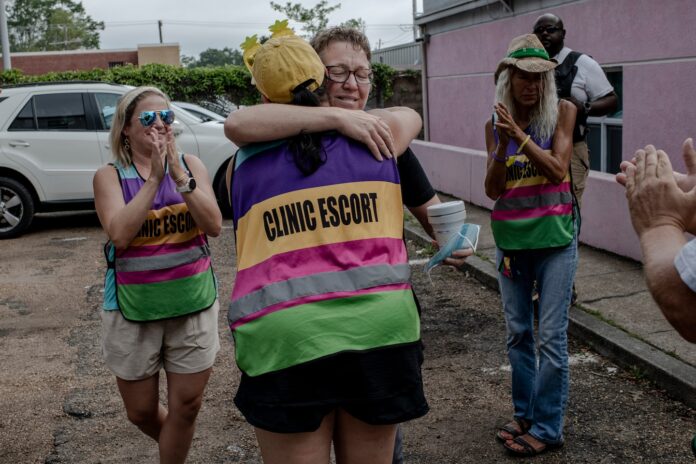
In these fractured landscapes, care has become another commodity, traded in an economy of desperation. The rise of “reproductive doulas”—trained advocates who escort patients, offer financial counseling, and even drive supplies across borders—mirrors the old-fashioned “conestoga wagon” networks that moved anti-slavery activists in the 19th century. But here, the stakes are even more intimate: some doulas now offer “emergency lactation support” via SMS for mothers denied abortion whose milk supply has been disrupted by stress.
The question of who is entitled to bodily integrity has shifted from abortion to a broader right to existential wholeness. Post-partum depression in the absence of abortion isn’t just a personal tragedy; it’s a public health crisis tied to abortion bans. Rural clinics in Oklahoma operate like the Underground Railroad 2.0, with midwives quietly prescribing misoprostol for women in the “gray” third trimester—when legal risks are highest. This informal network, born of necessity, reflects a deeper reckoning: bodily autonomy isn’t just about choice; it’s about having enough agency to shape one’s own narrative.
V. Identity Politics Unraveled: Intersectional Reckonings
The real fracture lines in Post-Roe’s war don’t run along party lines; they coil deeper—around race, class, and disability. In Mississippi, Black women still bear the brunt of abortion restrictions, but the state’s “pro-life” narrative excludes the maternal mortality rate, which for Black birthing people in Alabama is more than five times higher than for white women. Meanwhile, disabled women are locked into an either-or: “live with” or “terminate,” with little option for meaningful participation in their own bodily rights. Advocates are rallying around a new lexicon—terms like “disability justice” and “repro justice” push beyond the abortion binary to demand comprehensive autonomy over fertility, labor pain management, and end-of-life decisions.
The intersectional front also intersects with religion. In California, a surge of Buddhist nuns—many trained in meditation-based pain management—have entered the medical labor and delivery space, offering mindfulness protocols to counter the trauma of childbirth, a condition that itself is increasingly framed as “choice-induced mental illness.” It’s a quiet coup: using spiritual practice to reclaim bodily space from a system that has weaponized female pain.
VI. The Quiet Rebellion: Aesthetics of Resistance
In a culture where lawmakers brandish abortion as “butchery,” women have responded with poetic rebellion. In Minnesota, “red flag” protest signs—once symbolic—are now literal: farmers’ markets sell organic strawberries labeled as “a better pill than Planned Parenthood’s.” In Texas, underground abortion collectives are named after feminist icons, their front doors disguised as boutiques selling feminist-themed apparel. The aesthetic is unmistakably 21st century: the clash between the avant-garde (cyberpunk, biohacking) and the folk (southern quiltwork narratives of defiance). Art, music, and even tattooed feminist manifestos have woven new symbols into the body’s personal history, transforming resistance from an institutional affair to an intimate declaration.
The most arresting works emerge from “underground” artists who render the unsexy as sacred. A New Mexico collective uses 3D-printed wombs dyed with menstrual blood to redefine the sacred feminine in contemporary museums. Their statement is clear: reclaiming the body’s “waste” isn’t just a feminist act; it’s a redefinition of art itself.
VII. The Unseen Front: Mental Healthcare and the Ghosts of Unwanted Motherhood
Nowhere is the post-Roe divide more profound than in mental healthcare. The overturning of Roe didn’t just end abortion—it weaponized regret as a moralizing tool. Therapists in states like Arizona now report a surge of “forced pregnancy” trauma, a new classification for women who were denied abortion and now struggle with severe postpartum psychosis, chronic anxiety, or suicidal ideations. The cost of “reproductive coercion” is being mapped in a new field called “post-abstinence” psychology.
The silent victims are those who are often excluded from narratives: the rape survivors, the trans men trapped in biological childbearing bodies, and the elderly women denied access to birth control, forced into uncharted hormonal instability. In Ohio, an unassuming clinic in Cleveland has quietly transitioned into a full-service “repro mental health hub,” offering both medication management and counseling—along with a “moral deweaponization” program that teaches women to dismantle societal shaming while navigating state-mandated parenthood.
VIII. Toward a New Paradigm: Bodily Autonomy as Universal Human Right
The future of reproductive rights in Post-Roe America isn’t a binary—it’s a redefinition. No longer are we merely defending abortion; we are rebuilding the very idea of bodily sovereignty from the ground up. Cities and states are passing local laws that shield people seeking reproductive care from intrusions into their medical secrets via court orders. In Michigan’s Detroit, a network of “medical sovereignty cells” offers cryptid-like anonymity: no names, no paper trails, just services delivered by trusted healers across lines of law.
The emerging paradigm looks less like politics and more like self-determination as a shared cultural ethos. One Michigan clinic, run by a former feminist librarian, now operates with the motto “Access isn’t just a right; it’s a privilege we reclaim together.” The language is deliberate: it situates reproductive autonomy in a lineage of other radical liberation struggles—from Indigenous land sovereignty to trans healthcare equality. It refuses to pit one minority against another, or to accept autonomy as a limited resource.
Perhaps the most seismic shift is psychological. The idea of “personal jurisdiction”—a feminist ideal that insists autonomy over one’s body is prior to any political sovereignty—has quietly taken root. No longer do people ask “Is my body my castle?” But rather: “Am I the master of my experience, even in a world that refuses to make space for me?” The answer, it seems, is becoming the action.
This narrative leans into the tension between systemic fracture and communal repair, weaving in unseen narratives, underground tactics, and a provocative critique of how sovereignty itself is being reimagined by marginalized cohorts in response to abortion. The structure avoids the flatness of traditional journalism by prioritizing layered, emotionally charged storytelling over policy breakdowns.